Sunday, July 2, 2023

Do you see what I see? (Many would see an empty office. I see a future classroom).

Global markets are actively exploring how to repurpose now empty office buildings, as the post covid impacts of work from home and distributed employment take their rising toll. Typically, it is the older style office buildings which are most affected. Owners of premium office property compete more aggressively for premium, large-scale tenants who still want the high performance CBD workspace, while the lower graded buildings are often rendered uncompetitive. 

Conversion of office buildings to residential is something being explored in markets from Manhattan to San Francisco to London and also here in Australia, but there are a multitude of challenges in converting floor plates designed for office workers using shared facilities (such as toilets) into multi-tenanted apartments each with their own facilities. These challenges have more merit in markets where housing is blisteringly expensive (think Manhattan or London) but even there, the conversion costs are significant and, in many cases, insurmountable (much depends on the building itself).

But as our cities hurtle toward the addition of over a million new residents, there’s a conversion opportunity which to me makes a lot of sense, and one which could be achieved at lower conversion costs. Think schools. Here’s why. 

The latest Queensland Government Statistician’s projections for population growth mirrored those for many of our major cities: a lot more people, in a short space of time. For the Brisbane region alone, their medium series predicts an additional 1.2 million people by 2046. 

That figure includes an increase of 630,000 children in the 0-14 age group and while the QGSO notes this cohort will reduce as a share of the overall population (due to our ageing profile), the increase of 630,000 kids is a number that will need to be accommodated.

To keep the math simple, assume 500,000 of that cohort will be school age, and assume a typical school size of say 500 students (averaging across independent schools which can be smaller and state schools which are typically larger). There’s perhaps 1,000 new schools required.

Where will they go? These projections are for the Greater Brisbane area. The predictions for where growth in the school age population will occur within Greater Brisbane vary. In the Brisbane City Local Government Area (LGA) for example, there’s only a predicted increase of 6,610 in the 0-14 year age bracket. (Which is still 13 more schools). 

In Moreton Bay, the increase in school age children is predicted to be much higher – at nearly 40,000. And in Logan, the increase is nearly 30,000. That’s a lot of kids and a lot of space to find for a lot of schools within the urban footprint.  


The challenge is greatest for areas which are largely built out, but where density is increasing. How do you infill new schools? There just aren’t large chunks of land of several hectares ready to accommodate new schools with sports fields in areas already urbanised. 

Back to our repurposed office building scenario. Australia is only starting to get used to the idea of vertical schools, but they’ve been around for a long time. This (below) is picture of the primary school I attended in Hong Kong (where I was born and raised until end of year 6). As I am now officially old, this was obviously a long time ago. The school though, like me, is still standing. Year ones were on level one, year twos on level two, and up it went. (Fun fact: Michael Hutchence of INXS attended this same school at the same time.  He was three years older than me, so a couple of floors up). On the roof was a canteen and caged in play area. On ground there were play areas in under crofts, and a couple of basketball courts. No grass. We shared an oval up the road with multiple other schools, each allocated their timeslot. Somehow I managed to finish primary with an education which was possibly two years ahead of what I did in year 7 at primary school in Australia (Kenmore State). The lack of open space didn’t impact my education. 

In terms of building size, schools are fairly hungry users of space. Have a look my school in Hong Kong for example. Here in Australia, schools of several hundred students need roughly 10,000 square metres of floorspace. Some, like Brisbane’s new vertical Fortitude Valley State Secondary School, are closer to 25,000 square metres gross floor area (it was designed for up to 1500 students and cost $100m to build). 

Now, tell me how many single tenants you’re aware of with a requirement of potentially 10,000m2 to 20,000m2 and who need long term leases, and you might see where I’m going with this. 

But why would a school want to occupy an office building in a CBD?

Location is one reason: the CBD is probably the best served in an entire region by public transport – of all forms. That centrality also means the school could be accessed from all points of compass, meaning its physical catchment could be city wide – it isn’t restricted to just one side of the city. Keep in mind that schools have traditionally been based on local catchments: back in the day, kids used to walk or cycle to school. On their own! Now, parents seem prepared to drive some distance to drop little Johnny or Mary at the school gate. Local catchments are becoming less of a consideration, especially in the non-government sector. 

Lack of available sites for new schools is another driver. When you simply don’t have the space in infill suburbs, what do you do? Following a well-established trend that is decades old elsewhere in the world by putting schools in central locations is a logical option. 

Schools seem to benefit most from proximity of students with each other and with their teachers. Remote learning is unlikely to take off in the same way as remote working, so office buildings which offer that proximity advantage make sense. 

Building design is also amendable for school use. Similar to offices, education is primarily a day use function. Shared learning spaces, shared toilets and shared facilities. Fire, building and other relevant codes that are designed for a comparable intensity of floorspace use. (Remember offices at one point got to just 8m2 per person!). No planning reasons why not, and in terms of accreditation by education authorities, potentially easier than some alternatives. 

Entire floors could be dedicated to physical education – soft-fall but enough room for half courts for basketball, soccer, gymnastics etc. If outdoor sports is essential, buses take students and coaches to nearby parks and playing fields – just as they do elsewhere in the world. It’s very feasible. 

This idea logically suits secondary grade office buildings, and those closest to transit hubs (train and bus) will rate best. Conversion to education use will depend on the building and the needs of schools, but will be less costly than office to residential conversion in most cases. If you are faced with the option of building a new vertical school for $100m+ (provided you can find a site) versus buying and refurbishing an existing CBD office building for less, the sums on the surface at least look interesting. 

This could also better suit secondary as opposed to primary schools: we seem too protective of our primary school age kids to consign them to school buses or (gasp!) catching the train, but for secondary school age children, catching a train or bus from your suburban home into the city for school is no different to what office workers have done generations before. The entire CBD infrastructure is designed around this hub and spoke model. If there are fewer office workers needing to make this journey now, then why shouldn’t students take advantage of generations of investment in public transport networks, and the amenity offered in the CBDs? Plus, there’s nothing quite like education to activate a space. And CBDs need activation. 

Sure, this isn’t something that will be seized on by multiple schools quickly, but I have no doubt it will happen. It’s already started in fact. You would be surprised at the number of non-government secondary or special needs education establishments already occupying former office space in and around our CBDs. 

If a city region is planning to absorb 1.2 million more people (as is Brisbane) in a relatively short space of time within existing urban boundaries, it needs to do much more than talk about just housing. There’s a need for workplaces, for health facilities, and a need for schools (amongst a very much longer list). In our case, potentially 1,000 new schools. Some of that demand will result in much bigger schools in existing locations, and much larger class sizes. And some of that demand might just find its way to a CBD building or two. It only takes a small number of schools to potentially generate demand for tens of thousands of square metres of space. 

It’s something worth investigating. 


Wednesday, June 7, 2023

No Noddy, you and Big Ears won’t solve housing with a tiny house

One of the more infuriating ideas that seems to have more followers than it deserves is the notion that “tiny houses” are part of the solution to the housing affordability (and availability) challenges being faced in large Australian cities.

“Tiny houses” are variously defined, but Wikipedia offers a useful description: “The tiny-house movement is an architectural and social movement that advocates for downsizing living spaces, simplifying, and essentially "living with less." According to the 2018 International Residential Code, Appendix Q Tiny Houses, a tiny house is a "dwelling unit with a maximum of 37 square metres (400 sq ft) of floor area, excluding lofts." The term "tiny house" is sometimes used interchangeably with "micro-house". While tiny housing primarily represents cheap, simple living, the movement also sells itself as a potential eco-friendly solution to the existing housing industry, as well as a feasible transitional option for individuals experiencing a lack of shelter.”

Think Gypsy wagons. Alluring as the description is, the tiny house promise of being eco-friendly and low cost ignores one very inconvenient truth: the land on which it sits and the services provided to that land – if they meet the bewildering array of standards and regulations – are anything but low cost (or even eco-friendly).

This was dramatically highlighted by some recent research from the engineering team at Colliers (who acquired Peak Urban). According to their research, which is based on cost estimates for around 6,800 lots and 3,400 in construction, across seven regions in South East Queensland, the civil construction cost per lot is now $157,833. This is 37% more than their 2021 estimate.


Remember, this is just the civil infrastructure cost. It does not include the raw land cost – it is just the cost of providing services to that piece of land – water, sewerage, roads etc. Those services need to meet increasingly higher standards which, combined with today’s market realities, are driving the cost surge. According to the Colliers Report:

“Increases in civil construction costs due to supply constraints are the most obvious reasons for increased overall costs. However, skilled labour shortages have meant that some businesses are paying overs to get people (if they can get them), but it also means that it is taking longer to get things done. Authorities are suffering the same, with some being forced to contract works to external parties which further diminishes industries capacity to keep up. It’s a perfect storm that is leading to higher input costs across the board.”

Ironically, some of the drivers of these costs relate to standards which aren’t always the most eco-friendly or cost friendly. Arguments against “out of sequence” land development, for example, usually revolve around the roll out of trunk infrastructure (things like water and sewer mains, or roads for example). The argument being that the trunk infrastructure must be supplied in a sequential manner for cost reasons. Yet large scale off-grid infrastructure options – water collection or waste water treatment for example – which can provide environmentally superior and lower cost solutions, are often prohibited by regulation. You are not allowed, for example, to use collected rain water for anything but flushing your toilet or watering your garden. We have standards! And your wastewater must be pumped many kilometres through expensive concrete sewer pumps and energy hungry pump stations to reach a waste water treatment plant, even though large scale localised treatment options are technically available and environmentally superior. Once again, we have standards! Using recycled materials for road surfaces? Standards again.

So back to our tiny house. The cost of bringing services to the land on which it sits is now around $150,000. The land is also subject to a per-lot infrastructure charge, and the developer who has generated the lots has been subject to a range of taxes from land taxes to stamp duties to application fees and other regulatory and compliance costs. Plus there’s the actual cost of the raw land. You can see how the physical cost of a block of land – even one as small as 400 square metres – is now starting at around $250,000 or $300,000 – and that’s at the lower end (depending on location).

Then you get the pleasure of adding the house, which is also subject to a range of compliance costs and taxes – including the GST. According to the Housing Industry Association (2023):

“In 2019, the Centre for International Economics (CIE) released a research report Taxation on the Housing Sector which identified the costs associated with bringing land and housing to market and provided a breakdown of these costs as either resource costs, regulatory costs (red tape), statutory taxes (federal, state and local) or excessive charges. The research showed that the combined costs of the statutory taxes, regulatory costs and excessive charges equate to 50 per cent of the cost of a new house and land package. The situation since 2019 has only worsened.”

Many years (2007), when I prepared a report “Boulevard of Broken Dreams – the Future of Housing Affordability in Australia” for the PCA – that cost was around a third. It’s now half. No wonder things are getting worse. (If you want a copy, I can email you one just let me know).

Even more concerning is the equity argument. Buyers of an entry level new house and land package on the urban fringe – our archetypal young family of first home buyers – will pay a great deal more in embedded taxes and charges on their new home than someone buying a multi-million dollar established home in, for example, the privileged inner-city market of New Farm (or Balmain for a Sydney equivalent). Our young buyers are buying into an area where the infrastructure is largely still a promise of things to come. Our New Farm buyers are buying into a market where other taxpayers have generously funded the extensive hard and social infrastructure which has made the suburb so desirable, but they pay no infrastructure levy, no GST, and no other regulatory or compliance costs. They may grumble about stamp duty but it is far less than the combined tax bill faced by our young family.

So, the solution to this mess of regulation and tax, which has made new land for housing a complex and costly exercise, is to suggest building a tiny house of less than 40 square metres on land which costs over $150,000 to service, let alone the cost of the land itself?

Sorry Noddy and Big Ears, it’s a nice idea, but we’re in the real world now.

Sunday, May 14, 2023

No, we can’t address affordability by building lots more apartments


One of the (many) furphies that gets aired (frequently) in discussions around housing affordability is that we can build ourselves out of the problem by building a lot more high-density housing units rather than typical detached suburban houses.

In fact, the opposite is likely to happen should we attempt this course of action. Here’s why.

First, the reality of construction economics is such as that every square metre of space in a high-rise apartment building is more expensive – roughly double or more – than the same square metre of space built in a detached single level home.

The traditional “sticks and bricks on slab” construction of detached suburban housing has been incredibly efficient over a very long period of time. As a building form, it lacks complexity (despite recent moves to introduce it via new standards). It’s even been said that in post-World War II Sydney, as many as a third of the new suburban homes were by owner-builders.

Despite recent and rapid cost escalations, the build cost per square metre of a low-set detached suburban house is still around $1700 for the modest spec home. Not including the land, you can still find project home builders who will give you the keys to a brand new three bedroom, two bathroom house from around $220,000 to $300,000 – and that’s for roughly 200m2 under roof.

It’s a different story for multi storey apartments. These are more complex structures, with a good deal more going into them – more than just concrete and reinforced-steel slabs (which are themselves more expensive than timber frames or bricks for a low set house). There are also lifts, fire systems, standby generators, deep foundations and excavations for basement car parks… it’s quite a list. Building them also takes a lot longer than a standard house and involves at least one tower crane, sometimes more.

All of which means each square metre of floorspace in that high rise unit tower is going to cost around $4,000/m2 for a structure of basic design. This applies to the whole floor of course – corridors and common areas included. The cost per metre for the actual living space, developers and QS’s tell me, is closer to $5,000 per square metre. So a unit of 120 square metres will cost around $600,000 just to build. Not including the land or other development costs. This is around half the size but twice the cost of our detached new stick-and-brick example above – which includes builder margin.

Market prices need to factor in land and other development costs. The new low set detached house and land package will set you back from around $500,000 to $700,000, depending on location. (This is the discount end of the market of course). New home units however are well above this. Try finding a new three-bedroom apartment for $700,000 in Brisbane. Many are priced at $1m or more, even those well away from the urban core. (Spend a little while searching on realestate.com.au and see for yourself!).

What’s happening to the theory that we can solve affordability by building more apartments? It doesn’t stack up. You can’t “solve” affordability by building more of the most expensive building types.

It gets worse. Developers will know that, given base build costs plus land, infrastructure levies, and other costs (including allowing for a margin), they will have a minimum retail price they can deliver apartments for. The build cost is virtually the same in middle and outer suburbs as the inner city (land being the only differentiator). But in middle and outer suburban markets, the price points that people will pay are below the cost at which the product can be delivered. So it’s not worth doing. Instead, they will turn their attention to locations which can support higher purchase prices – and already well-off inner-city locations tick that box. There is less risk and a deeper market in building units that sell for over $16,000 per square metre (nearly $2m each or more) in any number of inner city locations, than trying to build lower cost units in suburban locations.

Which means the market supply of higher density housing will concentrate in and around the inner city where you will increasingly see new projects with price tags four times the Brisbane unit median. This is hardly doing anything for affordability.

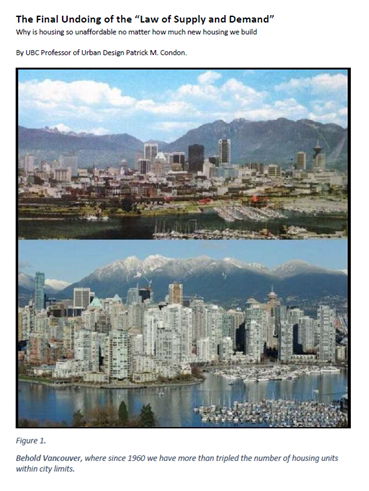
A similar thing happened in Vancouver, Canada. There, as Patrick Condon (James Taylor chair in Landscape and Livable Environments at the University of British Columbia’s School of Architecture and Landscape Architecture and the founding chair of the UBC Urban Design program) points out, the city tripled its housing via high density infill: “this was an unreservedly good thing – in all but one respect. This giant surge of new housing supply did not lead to more affordable housing as we all hoped. Somehow, confoundingly, the reverse happened.”

Sure did. Vancouver became the world’s least affordable housing market. Not a great outcome if affordability is your objective. Don’t be like Vancouver.

Last words:

Yes, townhouses are a halfway point in build costs. Suburban renewal precincts with townhouses or low set apartments are a more affordable answer, but even this is a challenge given construction economics.

No, outer suburban detached housing will not result in more people trying to get to the inner city for work. These buyers typically don’t work in the inner city. Inner city workers are typically higher paid. In New Farm for example, one in five households earns over $4000 a week. Inner city markets are high income markets with high-cost real estate. These people typically don’t work in the suburbs at a hospital or in retail or in education.

Sunday, May 7, 2023

No, we don’t have “a housing supply crisis”

We have plenty of things we could call a crisis, but suggesting we have a housing supply crisis isn’t one of them. Here’s why.

First, recall that the immutable law of economics 101 is called “the law of supply AND demand.” The two work together. In periods of high demand, the law states that supply will normally respond with increases. Failure to do so will see prices rise. In periods of low demand, supply should also fall. Failure to do so will see prices fall. 

Looking at supply of housing commencements on a national basis, it’s hard to see a crisis. Sure, early 2023 figures are low, but the longer-term trend should provide some comfort.

What about the demand side? Our rate of population growth has come off the Covid-induced shut down and is headed for the moon. It’s both a very rapid increase (almost vertical) and at total levels that are themselves records. This is almost entirely the result of immigration policy. In other words, it’s deliberate. 

So combine very rapid increases in demand and record levels of overall demand that are well in excess of what the market can supply and guess what – prices rise, vacancies fall and we start calling this self-inflicted situation a crisis.

There’s another reason that “housing supply crisis” doesn’t ring true, and that’s because building houses is still – despite high profile builder collapses – relatively easy. It’s the land to put them on that we’ve made a herculean challenge. Sure, there’s no shortage of land in Australia but economists who don’t understand the delights of our planning systems would have little idea how hard it is to find suitably zoned land, either serviced or capable of being serviced, in or near locations where people seem to most want to live. This artificially induced supply constraint has been supported in the interests of combatting sprawl. Yet it is also having the effect of reducing the supply side response. Bringing land to market is now a minimum 5 year (in some cases longer) proposition for many larger urban markets. It’s also costly. 

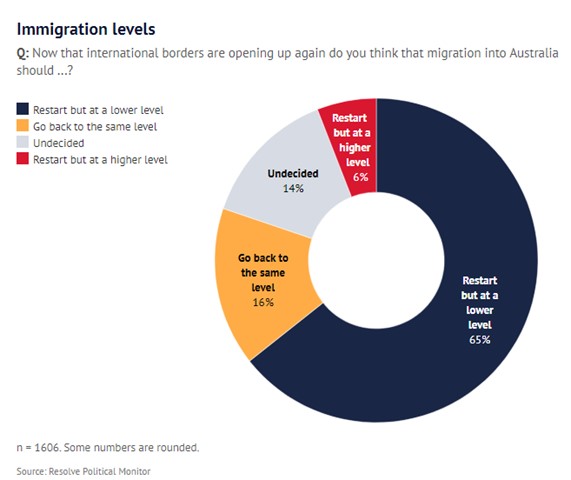
(Ironically, when asked, many seem to respond in favour of sprawl – allowing more homes in new suburbs outside city centres was the most popular response to a range of options offered in this 2023 Resolve Political Monitor poll. The least popular? Allowing more apartments to be built within existing city areas):

So what I’d suggest is that we don’t really have a housing supply crisis, but instead we have a growth crisis. Not just a shortage of zoned land to build houses, but shortages of hospital beds, of schools, of transport infrastructure, even looming shortages of potable water and energy. 

How can pumping our population growth to record levels and doing so at warp speed, given what we know from bitter experience about our unresponsive regulatory environments, not end badly? 


Saturday, February 11, 2023

Why do we keep falling for the idea that the rate of population growth in Australia is inevitable?

There is nothing inevitable about the rate of our population growth in Australia. So why does so much of our urban planning assume that the rates of growth are something “we can’t do anything about” when the opposite is in fact true? Only recently we proved it can be done when we pulled the policy levers on growth to ‘halt’ for the first time in many decades - thanks to Covid. Given planning for growth is about demand as well as supply, why is it we seem to accept rapid growth as ‘fate’ rather than plan for growth at speeds we can actually handle?

Our population clock shows there are now nearly 26.3 million of us. The biggest driver of that growth is net overseas migration – which is a direct result of national policy. When net overseas migration slows, our overall rate of population slows. Our natural (births over deaths) rate of growth is very modest by comparison and (unless you’re adopting a Community China approach to birth control and family planning) is beyond the reach of policy makers.

So population growth in Australia is invariably a discussion about net overseas migration numbers – something we seem sensitive about lest we be charged with racism or some other allegation. Nearly every country around the world views control of its borders as a primary responsibility, and with it, management of its own population. We are no different.

Australia’s rates of net overseas migration really took off in the early 2000s. After bouncing around at the 100,000 per annum mark for the best part of 50 years, it surged to double that and momentarily to triple that before crashing to negative as a result of global Covid border shutdown:


Ironically, the rapid acceleration in rates of net overseas migration followed a 2001 pre-election speech by then Prime Minister John Howard, who seemed to suggest the opposite was coming:

“I hold very strongly to the view that this country has an obligation as part of the international community to conduct a generous refugee program and we have done so to our credit now for some decades. We are one of only nine countries in the world that has a resettlement program and we take more refugees on a per capita basis than any country in the world accept Canada. But my friends we will decide who comes to this country and the circumstances in which they come and we'll decide that applying humane equitable principles and international refugee assessment. What is involved in this debate about asylum seekers is the proposition that some people have, namely if people can quite literally present themselves at Australia's borders and demand entry no matter what the background or no matter what the circumstances are.

That won him much support at the time, and the phrase “we will decide who comes to this country and the circumstances in which they come” has become one of his signature lines. The speech was in response to national security concerns flowing from global terrorism but was also widely taken to refer to immigration policy generally. But population numbers boomed to record levels in the next term of his office as Prime Minister.

The ALP too have had views on our rates of population growth. Labor Prime Minister Anthony Albanese, when he was Opposition Leader, called for a “mature debate” on population growth rates. In response to an Infrastructure Australia report that warned rapid growth rates would require $40bn per annum in spending, he had this to say:

“It’s a matter of appropriate population growth… What we can’t have is what has historically happened of just opening up land release, growth in outer suburbs, people not located near jobs without working out where they will work, where they will access health and education services, where their kids will play.”

“There is a role for government in just not allowing the market to let rip and having significant development occurring without looking at the social infrastructure that is required in order to improve liveability and sustainability.”

Now elected to office, that debate hasn’t happened. Instead, our rates of net overseas migration have been again set at record high levels.

To illustrate the speed of that growth, consider this graph which compares the various rates of predicted growth in our three major cities (where most growth pressure is occurring) with a range of global cities. While other cities (such as LA or London or San Francisco) may be significantly larger in number, their rates of growth are much slower. Since I did the research for this graph, LA and San Francisco have entered negative territory. In the case of LA, the US Census Bureau said it had “the largest population loss of any county, losing 159,621 residents in 2021.” This hasn’t led to a collapse of the LA economy.

Our rates of population growth, pre-pandemic, were three times that of many global cities we like to compare ourselves with. They are comparable only with the hyper growth rates of cities like Shanghai and Beijing in Communist China. Let that sink in.

The consequences of our inability to deal with these very rapid rates of growth are everywhere – housing shortages, hospital shortages, school shortages, rising congestion (doubling the population of a city but relying on the same transport infrastructure networks that were there in the 1980s will do that!), potable water shortages, energy shortages, shortages of parkland… if you think we’re doing OK you’re very much in the minority. (A recent article of mine went into some of these shortages in more detail).

What does the Australian population think of these rates of growth? Invariably, whenever their opinion is asked, the answer isn’t what the development industry or big business lobbies want to hear. A 2021 poll of Sydney and Melbourne residents for Fairfax media for example found that two thirds of residents wanted net overseas migration numbers to return at lower levels than pre-pandemic. Only One in five were happy with pre-pandemic levels or higher.

It's hard to suggest these somehow reflect racist views, given that both Sydney and Melbourne are highly multicultural cities and a diverse range of cultures would invariably be included in that sample.

So if rapid rates of growth are leading to obvious critical infrastructure shortages and eroding our quality of life in major cities, and if the majority of the population has significant reservations around the speed of growth and net overseas migration, why are we doing it?

There are arguments in favour of rapid growth – that it’s essential for the economy etc. Those arguments are often promoted by ‘big end of town’ interests motivated by selling cheap apartments or finding low-cost labour to plug labour resource gaps. Critics have argued that support of high migration policies are the equivalent of a pyramid scheme. Not all critics are cranks either, such as this article from the respected economist and journalist Terry McCrann:

“The next big battle for rational policy that adds value to Australia and individual Australians and not just dollars to the bottom lines and bank balances of developers, construction companies and assorted billionaires has to be over population. Two years of the virus put Australia’s ‘Population Ponzi’ on hold – the idea that you could build a healthy and strongly growing economy on simply bringing more and more people into Melbourne and Sydney, every year, forever. Yes, we got bigger aggregate growth in the economy, but we most certainly didn’t get quality growth, that actually improves the lives of ordinary Australians.”


The argument that we might be better advised to grow at more modest rates to ensure that our provision of critical infrastructure can keep up, and that our quality of life (and access to essentials like housing) doesn’t get worse, isn’t a discussion we seem ready to have.

Keep in mind too that the wealthy and privileged easily self-insulate from the adverse consequences of rapid growth, while enjoying the material benefits of it. They may promote higher infill housing density for their business interests’ sake, but rush to oppose it when a project threatens their own personal residential amenity. The problem of public hospital shortages doesn’t worry them either as they have the best private health cover available. Issues around state government schooling isn’t a worry, they have their children in the very best private schools. Rising household energy costs aren’t a concern for people who can afford $100,000 electric cars to openly demonstrate their eco credentials. And so it goes on.

There is nothing inevitable about our rates of population growth. They are the result of policy decisions we, as a nation, deliberately make. There is however something inevitable about the reluctance of our leaders in public policy, business and government to engage in an informed debate about the impacts of rapid growth and whether or not a more modest pace would benefit a greater number of people. 

Monday, January 16, 2023

‘HOSPO’ (the hospitality industry)


There are nineteen broad industry categories in Australia (based on the Australian and New Zealand Standard Industrial Classification) and 96 subdivisions. The attention-getters are things like retail trade, construction, professional/scientific/technical, education, and health care/social assistance. But what about the quiet achievers? What about, for example, the ‘hospo’ (accommodation and food services) industry, which has proven to be surprisingly resilient despite being practically outlawed during Covid lockdowns, and which by many accounts will continue to enjoy growth despite rising interest rates and abundant stories of falling consumer confidence?

First, some industry dimensions. Hospo employs nearly 1 million Australians, or 7% of the workforce. This handy infographic below from the Australian Government Labour market insights provides a useful overview. Past growth of 6.4% is predicted to double in coming years to 13.2%. Yes, it’s a lower paid industry with a low full-time share, but an industry showing growth of this magnitude is one that will experience more spending, which means elevated cash flows and share of wallet.

The Government’s Labour Market insights also reveals that, while industries like health and education along with professionals, have dominated discussions about jobs growth into the future (and with good reason), guess which industry comes in amongst the top five of nineteen? Accommodation and food services are predicted to be the fourth fastest growing industry of employment in the five years to 2026:


Predictions of growth for pubs, clubs and dining might seem counter-intuitive given the extreme pain inflicted by Covid lockdown policies, now compounded by predictions of a ‘mortgage cliff’ and consumer blood in the streets as the result of rising interest rates. But even taking these things into account, prospects for this industry seem solid. According to the Australian Industry & Skills Committee for example: “All Hospitality-related occupations are projected to show growth to 2026, with the strongest growth expected for Cafe and Restaurant Managers (27%), Fast Food Cooks (18%), Chefs (14%) and Waiters (12%).”  The food and beverage part of the industry, which has already bounced back from the Covid lockdowns, is expected to add jobs while the accommodation part of the industry remains flat:


What’s driving that growth is said to be our growing ‘foodie culture’ (which I think means an increasing willingness to eat out and to explore new food, dining and drinking experiences?). Added to this, a growing population and a bounce back in global tourism numbers provide a further floor to support future growth.

Global industry researchers Ibisworld are also talking up the industry’s prospects. Their 2017-2022 analysis was understandably dour: “The Pubs, Bars and Nightclubs industry has faced difficult trading conditions over the past five years. Rising health consciousness has constrained per capita alcohol consumption. Additionally, government regulations aimed at curbing binge drinking, alcohol-related violence and problem gambling have dampened industry performance over the period. The COVID-19 pandemic and related restrictions have substantially affected the industry over the three years through 2021-22, due to ongoing temporary establishment closures and subsequent capacity limits.”

But for 2022-2027 the tone is more upbeat: “Revenue for the Pubs, Bars and Nightclubs industry is forecast to grow over the next five years. Operators are projected to increase their focus on high-quality food and beverage offerings to appeal to value-conscious consumers and increase their revenue bases. Additionally, increased local tourism campaigns and support from the wider hospitality sector are likely to boost industry demand. Easing international border restrictions will support inbound travel to Australia, providing a much-needed boost to industry revenue” (while also noting that alcohol consumption per capita may continue to fall and gambling curbs are a further mitigating factor).

The Australian Bureau of Statistics’ Monthly Household Spending Indicator provides a further insight. The latest data, which runs through to November 2022, shows that household consumer spending continued undeterred by rising interest rates or predictions of economic calamity just around the corner. And the largest increases in spending? In order they were:

  1. transport (+35.8%)
  2. hotels, cafes and restaurants (+23.8%)
  3. alcoholic beverages and tobacco (+10.8%).

What is it with us Australians? Faced with rising mortgages and electricity bills, you’d think we would hunker down like some economic doomsday preppers, feeding off bulk cans of baked beans and Tom Piper stew (do they still make that? A staple of my student days!) stored in locked suburban garages? But no, we continue spending on dining, drinking, entertainment and travel. And according to these predictions, we’re going to spend even more. Somehow, we’ll find the money.

Is there something of the Australian psyche at work here? A few years ago, I had a CEO role in the hospitality industry (for a wine and restaurant brand). Just after I started, the GFC hit. The US market – a key export market – stopped spending on drinking and gambling (which affected a related parent company). But the Australian market didn’t stop. It just found other ways to afford it. It’s as if we value our lifestyle – which includes the freedom to visit a pub and pay outrageous amounts for a steak and cold beer, or pay through the nose for some fancy cocktail – so highly that these things are not so much “discretionary” spending, as closer to life’s essentials.

Of course, there are a great many people genuinely doing it tough. The working wage hasn’t kept pace with costs of living for a very long time. But in the meantime, there seems a large and growing cohort of people who are sufficiently immune from economic cold winds, that they can carry on unfazed.

2023 will be an interesting year to watch what happens across the economy, given that further interest rate rises are almost certain and talk of a global recession is gathering more support. But if you thought that an industry like hospo might be vulnerable and in for another body-blow, you might be surprised at how resilient it proves to be.

Postscript: Just when there’s every reason to expect consumer confidence will take a hit, turns out the opposite is true: the Westpac Westpac-Melbourne Institute Sentiment index rose by 5 per cent in January - the largest monthly gain since April 2021.


Tuesday, December 6, 2022

Spare a thought for NIMBYs


The dreaded “Not In My Backyard” reaction of homeowners who have the temerity to object to neighbourhood changes they never voted for (or were even asked about) is reaching plague proportions, if you believe what some urban designers and planners are saying.

This scourge of the NIMBY is threatening the progressive development of cities, they’ll allege. The NIMBY is now to blame for everything from housing affordability to urban congestion. Why can’t young Australians find a home they can afford? Because of those nasty, selfish NIMBYs. Why can’t seniors find a suitable property to downsize into within their own neighbourhood? NIMBYs again, curse them.

These comments from Brendon Coates at the Grattan Institute earlier this year are one example. Speaking at a Henry George Memorial Lecture, the NIMBY was given the full Kangaroo Court treatment, and found guilty without trial. “NIMBYs make housing unaffordable: Grattan Institute” roared the headlines.

According to Coates: “The key problem is that many states and local governments restrict medium- and high-density developments to appease local residents concerned about road congestion, parking problems, and damage to neighbourhood character.”

Let’s take a moment to consider what’s being said here and try see things from the NIMBY point of view. First, their home truly is their castle. Their home is the biggest single financial asset they are ever likely to own. Unlike their superannuation fund, it is within their control to add value and to enhance its appeal both as a place to live, and for long term financial security. And unlike their superannuation fund, there are no third parties in fancy CBD Offices charging them exorbitant fees to manage their home. A third of Australian households own their home outright, and a further third are paying it off with a mortgage. The remaining third are renting, and nearly all of that rental stock is also privately held by individuals hoping to build on their financial security via an investment in housing.

As property owners, they are all rightly heavily invested in what happens in their street and in their neighbourhood. For this reason, they are legitimately concerned about things like “road congestion, parking problems, and damage to neighbourhood character” – but according to Grattan, responding to these concerns is “appeasement” by state and local governments.

How disappointing it must be for these urban visionaries as they gaze out at the suburbs from their CBD glass towers, imagining all those ‘McMansions’ being bulldozed in favour of rows of townhouses and unit blocks, having to confront the objections of homeowners who defy the utopian urban density dream.

Incredibly, the suggestion seems to be that homeowners are not only being unfairly obstructionist in objecting to changes which might in their opinion diminish the value of their homes and assets, but that being a home owner should somehow disqualify you from having a say. According to Coates:

“The politics of land-use planning – what gets built and where – favour those who oppose change. The people who might live in new housing – were it to be built – don’t get a say.”

Meaning that non-owners who have no personal investment in a neighbourhood are being unfairly  disadvantaged because they are not getting a say about what happens to someone else’s biggest single financial asset and home?

Talk about egos and entitlement. “Father knows best” paternalism is a professional trait which happily tramples on homeowners interests if they dare get in the way of some “expert” opinion about whether their choice of home and location is “appropriate” or not. In 2019, the City of Brisbane prevented further development of townhouse style “missing middle” housing product in low density streets of detached homes. The uproar and indignation of some professionals at the time was a disgrace.

“The community doesn’t understand the full story because they are not experts in the field of City design and planning” said one town planner on industry portal Linkedin.

“It’s concerning that we listen to the general public for planning in our city rather than the experts who understand growth of a city,” said another. Wow. Imagine listening to the general public in a democracy? Why bother when you have unelected experts ready to tell you what’s in your best interests?

The so-called “townhouse ban” was in response to the feedback of more than 100,000 residents who responded to a widespread community survey “Plan Your Brisbane.” Planning Chair at the time, Cr Matt Bourke, said: “Their feedback was clear – no more cookie-cutter townhouses on properties that are intended for single homes.”

Neither side of politics will show much interest in pushing for policy changes which the people who elect them vigorously oppose. This is called democracy. When Labor Deputy Mayor David Hinchliffe gave the annual Keeble Planning Lecture in 2017, he observed that:

“If you push too hard for this [planning] ideal in the face of that [public] reality, it becomes a political issue in your community, you get defeated and the person who replaces you invariably has learned the lesson of your demise and will make it much harder for planners to wield that [policy] stick in their patch in the future.”

“In public life, if you don't learn that, you don't stay around long.”

Ironically, industry groups or larger developers who complain about the NIMBY phenomenon can at the same time be guilty of their own version of zoning protectionism. One look at how viciously the anti-competitive “retail hierarchy” planning laws (which effectively prevent further competition within defined trade areas) are fought out in court shows that self interest is a powerful motivator. “We would object to a competitor moving a pot plant if we thought it in our interests,” a senior Westfield operative once said to me. Doesn’t this make Westfield and other large corporates no different to the home owning NIMBY?

The attacks on NIMBYs though will continue. They will be accused (and found guilty) of everything from causing climate change to social inequity. The accusers will be the same usual cabal of unelected academics, urban “visionaries” and assorted media commentators whose own homes and lifestyles are no doubt safely protected from adverse policy changes while they lecture others on their selfish ways. And the tensions will only increase as competition for space and housing increases.

How will NIMBYs respond? That’s best left to Darryl Kerrigan – lead protagonist in Aussie film classic “The Castle”:

Darryl: Tell em to get stuffed!

(He also said: “What are you calling an eyesore? It’s called a home ya dickhead!)

Tuesday, October 18, 2022

Where we work defines how we get there (and explains a lot about the public transport challenge)


Where we work has everything to do with the transport choices available to us for getting there. For CBD and inner-city workers, transport choices are amongst the widest – including a variety of forms of public transport (ferries, buses, trains) along with more options for walking and cycling (thanks to the infrastructure but also because CBD and inner city workers tend to live close to the inner city).

If almost everyone worked in the CBDs and inner cities, the fantasy of public transport advocates (“we must get people out of cars and onto public transport”) could be realised. But the economic reality is that the proportion and number of jobs in CBDs and inner cities remains low and is likely to fall further in the future. The greatest majority of jobs are suburban, and these workplaces are typically not served by public transport.

Evidence of this economic reality is provided by the Census, for those who can be bothered to consult the data.

The graph below shows total job numbers for Southeast Queensland by location based on the Census results of 2011, 2016 and 2021. This is for all jobs – part time, casual and full time, and for all industries.


In 2021, Brisbane’s CBD was home to 146,393 jobs. In the 10 years since 2011, this had grown by 30,261 jobs (part time, casual and full time remember -  full time white collar professionals are a subset of this number). The inner city reached 235,441 jobs or growth of 49,067 since 2011 while the SA4 statistical area (very crudely approximating a 5 klm radius from the CBD) reached 364,268 jobs and growth of 77,488 jobs.

The greater Brisbane metro region by comparison was home to 1,194,277 jobs – an increase of 268,888 jobs since 2011. The SEQ region – which forms the basis of most planning frameworks – reached a total jobs pool of 1,702,408 or a decade increase of 481,896.

What this indicates is that the CBD and inner city are overall a minority destination for the 1.7 million employed in SEQ. Yes, the CBD/inner city is the largest single job agglomeration, but in terms of its overall share of jobs by location, we are talking a destination for a minority of the region’s employed. The CBD accounts for 8.5% of jobs in the region, the inner city for 14% and the wider 5klm ring (for which there seems no scientific or professional basis other than it’s a popular measure) for 21%. Even at the most generous spatial definition (a 5klm radius is a 10klm diameter - which stretches well into leafy suburban areas) there are 8 in 10 people who do not work in the inner city.

This lies at the root of the public transport challenge. The hub and spoke nature of public transport (which tends to serve the CBD and inner city) works for only around 10% to 15% of people with inner city or CBD jobs to go to. Increasing investment in public transport networks which reinforce this hub and spoke structure will not increase the proportion for whom PT is a legitimate choice (though it will no doubt add to the amenity and comfort of those for whom it already is).

Adding to the challenge is that, despite decades of adulation and the bestowment of almost mythical job creation and attraction powers, CBDs and inner cities are not growing as fast as job markets in metro and suburban regions. Technology (and now WFH) is eroding the numbers of jobs in inner city locations, while much faster jobs growth in health and education industries are fuelling significant job growth in suburban and outer areas. Finance and property was once (in the 1990s) in the top 5 growth industries. It is now bottom 5. Health and education lead growth on almost any indicator you care to consult.


Another way of looking at this is by what shares of jobs growth are going where. Over the ten-year period to 2021, the Brisbane CBD secured 6% of regional jobs growth and the inner city 10%. Metro Brisbane (for which read suburban business districts, strip centres, shopping centres and other locations) accounted for more than half.


This geographical pattern of job growth and contraction is reshaping our cities but sadly so much of our thinking remains rooted in the mistaken notion that “most jobs are in the inner city.” Inner city professionals in fields as diverse as public policy, government administration, academia, planning, property, law, engineering and the like seem to have fallen into the trap of thinking that everyone must be like them: commuting to inner city office towers. As the economy grows (they argue), many more jobs will be in the inner city so to address congestion, we must invest more in public transport networks designed to carry people from middle and outer suburban homes, to their inner city workplaces. There is no evidence to support this. The reality is very different.

There are things we could be doing. Exploring options around electric, autonomous vehicles (including as PT), along with more tunnels to move more suburban traffic (which includes, increasingly, freight). A more dispersed transport network that will serve an increasingly dispersed future economy. There are unexplored options around train stations as work destinations (not just as places to embark for a city bound journey). Plus there are many options for the development of mixed use suburban business hubs – suburban renewal which mixes housing, work and social infrastructure such that shorter trips are possible and bringing both jobs and services closer to where people live.

Former US President John F Kennedy once famously said: “The great enemy of truth is very often not the lie - deliberate, contrived and dishonest - but the myth - persistent, persuasive and unrealistic. Too often we hold fast to the cliches of our forebears. We subject all facts to a prefabricated set of interpretations. We enjoy the comfort of opinion without the discomfort of thought.”

That was way back in 1962. Are we really such slow learners?


(Future analysis of other capital city jobs geography coming soon).

Sunday, September 4, 2022

Is a housing shortage the least of our worries?

So, the “National Jobs & Skills Summit” succeeded in what seemed a predetermined outcome: to lift migrant numbers and boost our population once again. Permanent migration will be lifted to 195,000 per annum, to address “skilled labour shortages” that are “holding back the economy.”

Set aside that full employment would ordinarily see real wages grow (a much needed outcome of ‘supply and demand 101’ – and something that hasn’t happened for a long time), the acceleration of migration and population growth will have consequences. One of those is the question of housing, with a number of industry groups and ‘think tanks’ like The Grattan Institute arguing for measures to rapidly increase the supply of housing. Their preference is to overturn community objection to high and medium density housing, which they claim is restricted by local governments “to appease local residents concerned about road congestion, parking problems, and damage to neighbourhood character.” I mean, how dare residents object to congestion, parking and damage to the character of their neighbourhoods. Bloody peasants! (Incredibly, the Grattan Institute went on to say: “The people who might live in new housing – were it to be built – don’t get a say.” Which means that people who don’t live in a neighbourhood don’t get a say… but that they should? This dear reader is what passes for a think tank these days).

A housing shortage though is only one of the challenges. Most of the additional “skilled” migrant intake will settle in major cities, where congestion problems are mounting. Our skilled migrants (with a wage floor below the average wage) will not be flashy suit-wearing financial markets or property executives, catching shiny new public transport projects to their high-rise CBD towers from which they can view and rule over the world beneath them. No, they will be “nurses, teachers, aged care and childcare, hospitality, IT and other skilled workers (who) are holding the economy back”.  These workers and the industries they work in are suburban, which means getting to and from work with any semblance of convenience, will involve the private car. For every 100,000 extra people, expect 60,000 to 70,000 more cars on the roads. And given the lower wage profile of our skilled migrant intake, they won’t be driving $65,000+ Teslas, much to the dismay of wealthy inner urban Teals and Greens. No, they are more likely to be driving early model, emissions heavy vehicles – because that’s what they need and can afford.

Another shortage which is hard to ignore is health care. Barely a night passes without another news story dealing with chronic shortages in our health system. Admittedly, some of these shortages are labour related (which skilled migrants will help address) but others are physical – we haven’t been building hospitals in pace with population. This scary graph below from the World Bank suggests that today we have around one third the number of total beds (private and public) per thousand as we had up until maybe the mid 1980s. (What happened in 1999-2000?). Other sources paint a similar picture. Our lower income earning skilled migrants aren’t exactly going to be rushing for a $400+ a month private health cover policy, so you can safely bet a majority will – initially at least – be reliant on an already stretched public system.


Schools too may come under pressure. The public education system has served Australia well but with all major cities now embracing greater population density within existing urban footprints, we will need to find more places for more children in existing areas. Private or independent schools – for the same reason as private health insurance – are likely beyond reach of new migrants on lower incomes. I tried to summarise the challenge in A looming schools shortage?: “Every extra million people (as for example predicted for each of our major capitals in just a few short years) will mean an extra 160,000 students. At a rough average school size of 400 students, that’s another 400 additional schools for each million of extra population.” Finding land suitable for new schools will not be easy.  Happily, teacher-student ratios appear to have held up. The real growth in numbers seems to be administration and related roles (doesn’t that say something) but the pressure of rising demand for student places will surely exert itself soon.

Other more basic services will also be put under pressure. Australia’s energy grid is cracking, with falling baseload generation not yet being met by the promise of renewables. The Australian Energy Market Operator (AEMO) is warning that: “Electricity supplies are forecast to fall short of demand within three years across Australia's eastern grid, unless new renewable energy and transmission capacity is urgently brought online… Central to the upheaval has also been a spate of coal-fired plant outages, which at one stage in June affected a quarter of the fleet in the eastern states. AEMO said those supply pressures were likely to get worse in the coming years as five coal plants closed, taking with them 14 per cent of the National Energy Market's total capacity.”

An increase in skilled migration of course won’t be the reason the energy grid could run short of energy, but it is another reflection of policy-induced supply shortages (much like housing) which are now translating into higher and higher prices (much like housing).

Even one of the most basic commodities of an advanced nation – reliable drinking water – seems threatened with shortages. In fast growing south east Queensland, water utility organisations in 2021 warned in an official report that: “South-east Queensland will not have enough drinking water to support its rapidly growing population amid fears the region’s dams will struggle to supply millions of extra residents.” Building new water storages seems too politically charged, and governments can be divided on the best course of action. For many of our major cities, offshore desalination plants seem the fallback position. If only they weren’t so energy-hungry and could drain what’s left of the power grid. What, you want people to have reliable electricity AND reliable water?

It’s easy to be sarcastic. If only it weren’t true. I am one of those who believes our nation can readily support more people. In many respects, we need more people. But we are proving ourselves increasingly hopeless at it. This is just a cursory scan of some areas where our limited capabilities are becoming obvious. There are arguably many more. Pumping up the population intake at a time of critical housing, energy, hospital and even water shortages, without widely agreed plans to address those shortages, and without a coherent national settlement strategy and instead just jamming more people into already challenged and congested major cities, doesn’t seem like planning to me.

Maybe they need to hold another summit to think about it? They could open it with a reading of what author Donald Horne so acerbically once said? “Australia is a lucky country run mainly by second rate people who share its luck. It lives on other people's ideas, and, although its ordinary people are adaptable, most of its leaders (in all fields) so lack curiosity about the events that surround them that they are often taken by surprise.”